Burmilla cat ideal weight and nutrition
 |
| Burmilla cat |
The ideal weight for a Burmilla cat is 8 - 10 lbs (3.5 - 4.5 kg). For the suggested daily intake of dry food, consult the table below:
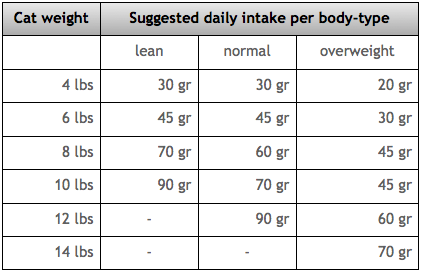
Table 1.1 - Burmilla cat daily food intake
In order to maintain the lean build of the Burmilla cat, as well as its playful nature and muscular build, its nutrition must contain high quality protein and reduced fat, as well as Conjugated linoleic acid (CLA) to produce muscle tissue over fat and L-carnitine to utilize fat reserves as an energy source. Although cat food companies have not yet developed special food formulas for Burmilla cat, you might want to mix meals specially designed for Siamese and Persian cats, meaning the not so far ancestors of the breed.
Burmilla kittens care
When you introduce a Burmilla kitten to your home let it find its own way out of the basket and allow it to explore one room at a time. Make sure that all doors and windows are shut, to prevent the kitty from escaping.
 |
| Burmilla Kitten - Photo by http://cats-pictures.org/ |
Kitties are very often frightened by children or other pets that are new to them. Children should therefore be recommended to be quiet and wait for the burmilla kitten to adopt to the new environment, while other animals should be introduced later, gradually and one at a time. Remember that adult cats might attack to the baby cat, since they confront it as a competitor and therefore as an enemy.
Talk to your kitty and encourage it to play with a toy but do not overwhelm it with extreme attention.
Burmilla kittens need warmth. If there is not some form of heating in the room at all times, you had better buy a heated bed from a pet shop.
During the first month of their life, kitties should be breastfeeding. This is why you shouldn't separate them from their mother before they are one month old.
At the age of one month they can start eating kitten food. In the market you will find a wide range of kitten meals, however we recommend dry kitten food. This comes in small kibbles that encourage Burmilla kittens to crunch and help them develop stronger gum and teeth.
For the suggested daily intake of kitten dry food, consult the table below:

Burmilla cat grooming
A Burmilla cat has smooth fine hair, so grooming and maintaining the coat is not an issue and it does a good job keeping itself clean. You will have to brush them once a week, as this helps with shedding. Use a comb with metal bristles and an elastic grip and work through the fur from head to tail to remove dead and loose hair. Be extra-gentle near her chest and belly to avoid injuring your Burmilla.
Tapeworms
Tapeworms are parasites that live in the small intestine of cats. They will cause severe diarrhea, poor or extreme appetite, avitaminosis, lethargy, coughing and abdominal distention to your cat.
To find out more, check our tapeworm treatment guide.
Hair ball
When a cat grooms itself by licking its own fur, it will swallow some of its own hair. Most of the hair passes all the way through the digestive tract with no problems. But if some hair stays in the stomach, it can form a hair ball.
To find out more, check our hair ball treatment guide.
Fleas
Even clean cats can pick up fleas, especially during the summer months. They get fleas through the contact with infested pets or through the contact with fleas in the environment (e.g. from an infected bedding).
To find out more check our flea treatment guide.
Cat care
You should clean Burmilla cat's ears once a week to keep them clean and prevent infections. Consult your vet on choosing the proper cat ear cleaning solution and use it to remove the excess of wax, debris and dead tissues.
Your Burmilla cat teeth should be checked periodically and brushed with a special wipe to prevent teeth and gum diseases. In the market there are also a lot of cat toys, specially designed to remove food wastes and prevent teeth irritation.
A litter tray must be available at all times and kept in the same place. Solid matter and wet lumps should be removed from the tray frequently and the litter renewed when necessary. The tray should be washed and disinfected frequently. Rinse thoroughly after disinfecting and allow drying before use. A Burmilla cat is very fussy and will not use a dirty tray.
Never give a cat any drugs that have not been prescribed for it; many human drugs are poisonous to cats. Seek veterinary advice immediately if you suspect any form of poisoning.
Make sure that cat toys or parts of them cannot be swallowed. Plastic bags and rubber bands can be extremely dangerous because they do not show up on an X-ray.
Burmilla cat health and lifespan
A Burmilla cat usually lives up to 13 years of age, but with the proper care and nutrition they can live up to 15 years of age.
The Burmilla cat does not have particular health issues, although it is possible to suffer from allergies. There are few records of Polycystic Kidney Disease (PKD), a disease that causes kidney failure and derives from its Persian ancestors. PKD symptoms include excessive drinking and urination, reduced appetite, weight loss and depression.
Burmilla cat history
The Burmilla breed was originally created accidentally in the United Kingdom. Early in 1981, Miranda Bickford-Smith bought a male Chinchilla for her husband. Shortly before he was due to be neutered, Jemari Sanquist met Bambino Lilac Fabergé, a lilac female Burmese cat, who had escaped from purdah. It soon became evident that kittens were on the way and on September 11th, four Black Shaded Silver females were born.
Soon after, the four kittens' spectacular look and superb temperament prompted their owners to try and establish a new breed. A mating between Sanquist and another of Burmese cat was arranged forthwith, which resulted in a single male kitten.
The cross-mating between Chinchilla and Burmese cats kept on to create a new breed that was officially registered in 1984 and gained championship status in the United Kingdom in the 1990s.
A name had to be found for the new breed. There were two options:
· CHIN(illa-burm)ESE was obviously most inappropriate
· BURM(ese-chinch)ILLA!
Burmilla cat personality
The Burmilla cat has the best features of both ancestor breeds. It bears the demanding and mischievous character of the Burmese cat mixed with the easy-going, relaxed nature of the Chinchilla. Impish and fearless when young, a Burmilla cat matures into intelligent and extremely affectionate adult cat.
The Burmilla cat is outgoing, friendly and sociable. Not as noisy nor demanding as Burmese cats, nonetheless more adventurous and inquisitive than Chinchillas.
The Burmilla cat is playful without being overly active, however quiet, with a laid back nature. Dribbling ping pong balls and retrieving pom poms is its favorite activities, which can suddenly come to a stop and your Burmilla comes to rest in your arms with a deep throated purr and a contented grin, not to mention an angelic look into its eyes, which is so much in character. It enjoys being a part of the family, actually it is great with children. This, combined with its low maintenance and wonderful disposition make it ideal family pet.
Due to this unique personality, extremely good nature and gorgeous looks, Burmilla cat is becoming increasingly popular.
Burmilla cat breed standards
According to the Fédération Internationale Féline, Burmilla is an elegant cat of foreign type.
The head is gently rounded on top and has a medium width between the ears. It is rather wide at the eyebrow level with wide cheekbones tapering to a short, blunt wedge.
The shows a gentle nose break when viewed in profile, however a bump nose is considered a fault. The chin should be firm with good depth, while the tip of the nose and the chin should be in line.
The ears are medium to large, broad at base with slightly rounded tips. They are set with a slight forward tilt when viewed in profile. When viewed from the front, their outer line continues that of the face. Nonetheless, this may not be so visible in mature males that develop fuller cheeks.
Their eyes are large and expressive, placed well apart in a slightly oblique setting. The upper lid forms a broken line angled towards the nose while the lower lid is fuller and rounder. Any shade of green is allowed, but clear green is by far preferred. In addition a yellow tinge is acceptable in Burmilla kittens and young Burmilla cats less than 2 years of age. Moreover in red, cream and tortie varieties amber is allowed.
The body is medium sized, with a rounded chest of medium width and a straight back. The bone structure is very good and though covered with firm muscles gives an impression of great elegance. The legs are strong and slender, with the hind ones being slightly longer than the forelegs. They end up to neat and oval paws.
The tail is medium to long, with a medium thickness at its base, tapering slightly to a rounded tip. The coat finally is short, dense, with a silky and smooth texture. It also bears sufficient undercoat to give it a slight lift. All recognized Burmilla cats are silver shaded or silver shell and can possess one of the following colors and patterns:
· Black
· Seal/Blue/Chocolate/Lilac/Cinnamon/Fawn
· Red/Cream/Tortie


